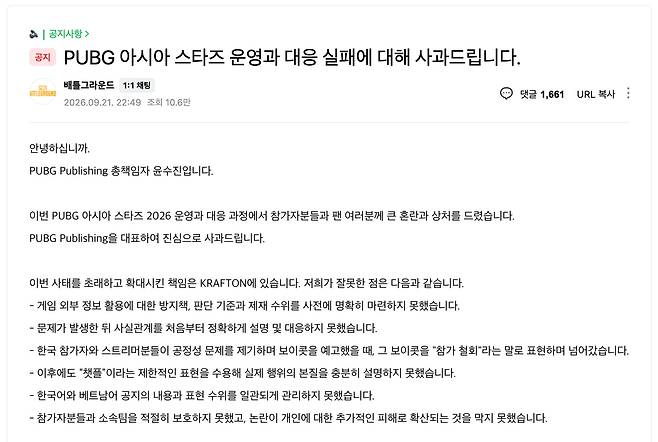
As tensions between Vietnam and South Korea continue to escalate over PUBG Asia Stars 2026, I have briefly gathered and summarized the Vietnamese side's perspective on the controversy.
1. Was stream sniping a voluntary decision made by Himass and TanVuu?
No. The two players had already asked the Vietnamese PUBG organizers whether stream sniping was allowed. They proceeded with it because the organizers told them that it was permitted.
2. However, from the Korean perspective, stream sniping is clearly considered cheating.
That may be true. However, in Vietnam, we viewed this event simply as an event intended for entertainment. We did not expect there to be restrictions on how the game could be played.
3. But this was a competition with prize money at stake. Wouldn't stream sniping be considered cheating by teams competing for the prize?
Yes. However, we focused more on the entertainment aspect of the event than on the prize money, so we did not see any reason to consider the issue from that perspective.
4. Then are you saying that the players who engaged in stream sniping were not the ones ultimately responsible for this situation?
That is correct. What matters is that they received permission from the Vietnamese PUBG organizers to engage in stream sniping and did not make that decision entirely on their own.
5. Ultimately, do you believe that this entire controversy was caused by a communication failure between KRAFTON and the Vietnamese PUBG organizers?
We do not know whether the Vietnamese PUBG organizers actually communicated with KRAFTON and obtained permission. However, KRAFTON also acknowledged in its official statement that there had been a communication error, and we believe this may be the issue it was referring to.
Conclusion: Who Should Be Held Responsible?
Based on these statements, I believe this entire situation arose from KRAFTON's shortcomings in managing the event and the poor decisions made by the Vietnamese PUBG organizers.
However, KRAFTON and the Vietnamese PUBG organizers, who should be facing questions about their responsibility, appear to be remaining silent while public attention and criticism are being directed toward SOOPI, Himass, and TanVuu instead.
This situation could also be interpreted as an attempt to shift responsibility onto the individuals involved rather than address the underlying organizational issues.
KRAFTON needs to issue an additional official statement as soon as possible to clarify what happened, explain the communication failure, and establish where responsibility for this controversy ultimately lies.
Anonymous comments